Vision problems in children are not always visible: a child can have amblyopia, significant refractive error or retinal disease while appearing to see normally. By tracking age-based milestones, recognising urgent warning signs and understanding what a complete examination involves, you can seek the right assessment and support healthy visual development.
Key takeaways
- Arrange assessment for a persistent eye turn or wandering eye.
- Track fixation, smooth following, reaching and accurate eye use.
- Seek urgent care after eye injury, sudden vision loss or severe pain.
- Follow prescribed glasses and review amblyopia or squint treatment regularly.
Which vision milestones should your child reach, and who needs earlier checks?
Newborns see light and large, high-contrast shapes, but vision is still immature. Infant vision development should progress from brief fixation to smooth tracking, reaching and accurate eye use. A delay, persistent eye turn or consistently wandering eye deserves assessment rather than watchful waiting.
| Age | Expected paediatric eye milestones |
|---|---|
| Birth | Briefly fixes on light or a face; pupils respond to light. |
| 6 weeks | Looks at faces and follows a bright target briefly. |
| 3 months | Fixes steadily and follows moving objects with both eyes. |
| 6 months | Tracks smoothly, reaches for objects and uses both eyes together. |
| 1 year | Reaches accurately, recognises familiar people and objects, and keeps the eyes aligned. |
| Preschool age | Matches or names pictures, shapes, symbols or letters; uses near and distance vision without a persistent squint. |
| School age | Reads age-appropriate print, copies from a board and coordinates both eyes for play and classroom tasks. |
A normal-looking eye does not rule out significant refractive error or amblyopia. Arrange a children’s eye examination after failed photoscreening or autorefractor screening; screening identifies risk, not a diagnosis.
Seek earlier or more frequent assessment for premature or low-birth-weight infants, including those requiring premature infants eye screening for retinopathy of prematurity; follow the neonatal eye specialist’s schedule. Also arrange assessment for developmental delay, neurological disease, genetic or systemic conditions such as diabetes, or a family history of strabismus or amblyopia.
Even without symptoms, routine screening is advised at least once between ages 3 and 5 years.
What happens during a paediatric eye examination?
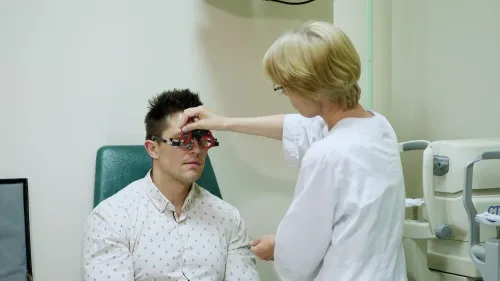
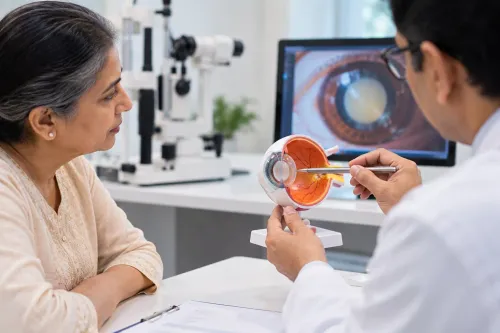
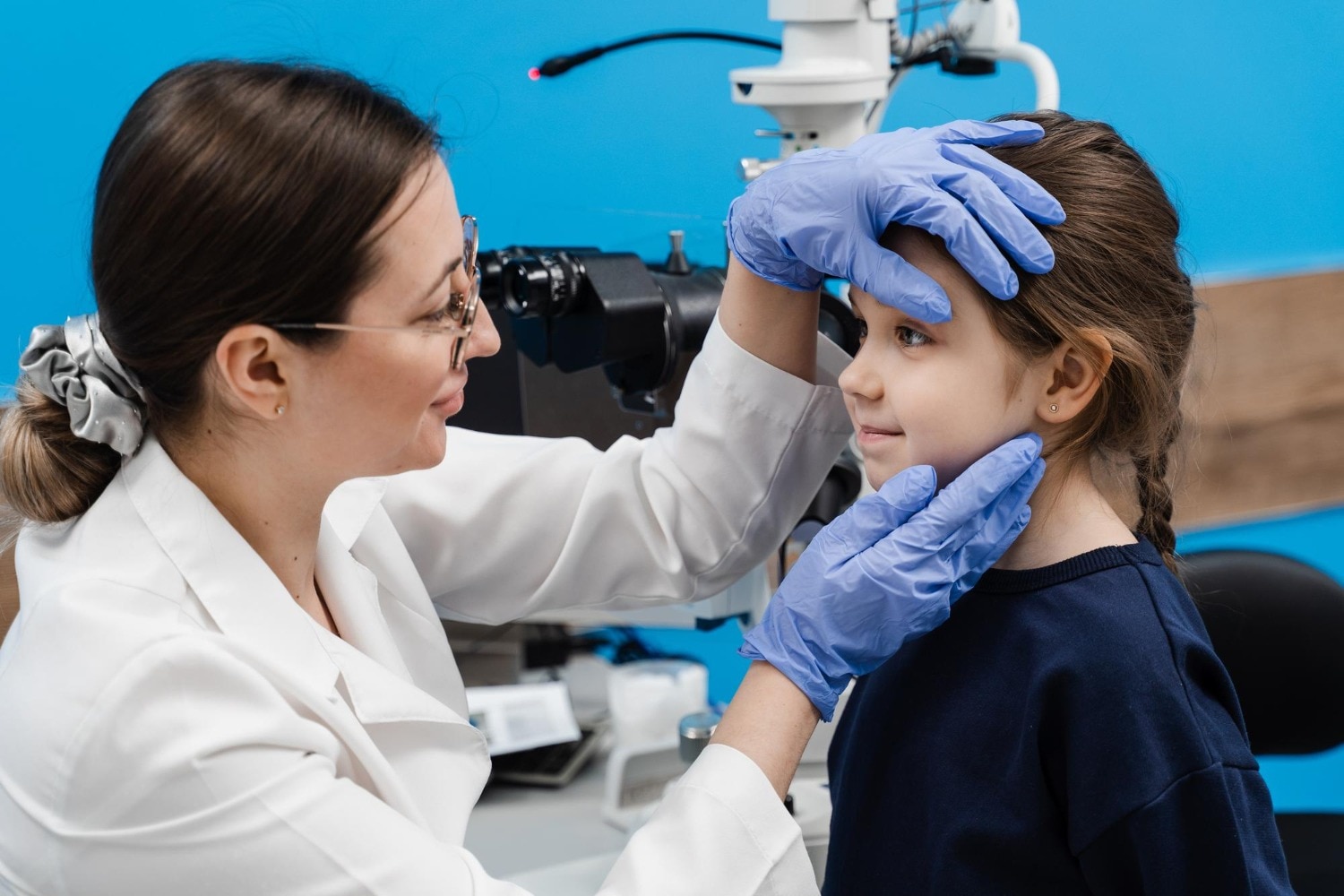
An examination adapts to what a child can communicate. A normal-looking eye does not exclude significant refractive error or amblyopia, so the clinician reviews birth history, development, family history and symptoms before checking both eyes.
The age-based assessment usually includes:
- Babies: The clinician performs a fixation and following test, watches whether each eye holds and follows a face or light, checks pupils and eye movements, assesses alignment, and examines the red reflex and retina after dilation.
- Toddlers and preschoolers: Photoscreeners or autorefractors estimate amblyopia risk factors when a child cannot read a chart. The clinician also checks alignment, eye movements, pupils and age-appropriate matching or picture-based vision.
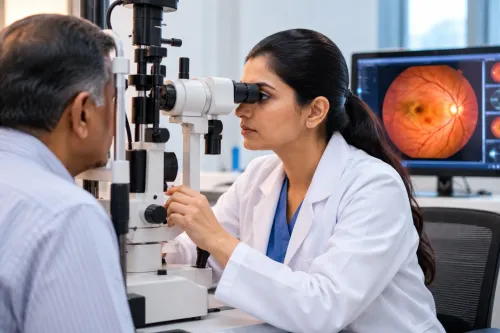
- School-age children: Visual acuity testing children can usually complete uses an eye chart, testing each eye separately and then together. The examination adds colour-vision testing, alignment checks, pupil responses and a dilated retinal examination.
A screening result is not a diagnosis. A child who fails photoscreening or cannot cooperate needs a complete paediatric eye examination.
Cycloplegic refraction is needed when the clinician must measure the underlying prescription, especially in infants, young children, suspected farsightedness, unequal prescriptions or unexplained reduced vision. Cycloplegic eye drops temporarily relax focusing; without them, active accommodation can hide hyperopia or distort the prescription. Drops can cause light sensitivity and blurred near vision for several hours.
Which eye symptoms need urgent medical assessment?
A white pupil in child photographs or in normal light needs prompt ophthalmic assessment. This finding, called leukocoria, can result from cataract, retinal disease or retinoblastoma; do not wait for a routine appointment. A new squint child develops suddenly, especially with headache, vomiting, abnormal eye movements or weakness, needs urgent assessment.
Act immediately when you notice any of these signs:
- New unequal pupils, a fixed pupil, or a drooping eyelid: treat this as an unequal pupils child eye emergency and seek emergency care.
- Painful redness, light sensitivity, reduced vision, swelling or severe discharge: obtain same-day medical assessment.
- A chemical splash: rinse the eye continuously with clean water for at least 20 minutes, remove contact lenses, and go to emergency care.
- A penetrating injury or suspected foreign body: do not rub, press, or remove the object; shield the eye loosely and seek emergency care.
- Repetitive jerking, wandering or shaking eyes: arrange urgent assessment, particularly if the movement is new or accompanied by poor balance or altered behaviour.
| Warning sign | What to do | Timing |
|---|---|---|
| White or yellow pupil | Arrange specialist eye assessment | Promptly |
| Sudden misalignment or abnormal movement | Seek urgent medical assessment | Same day |
| Painful red eye or injury | Protect the eye and seek emergency care | Immediately |
A photograph showing a white reflex is not proof of disease, but it is never a reason to delay evaluation. Pain, vomiting, marked swelling or sudden vision loss raises the urgency further.
How do amblyopia, squint and childhood eye disease affect vision?
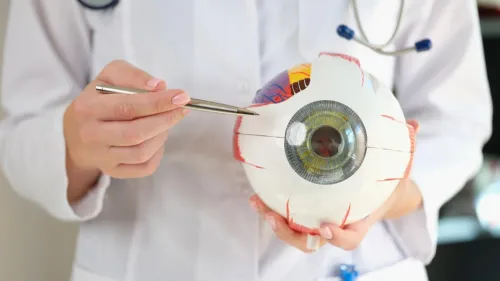
Amblyopia in children is reduced vision caused by disrupted visual development, not necessarily by damage visible in the eye. The brain favours the clearer image, so strabismus and amblyopia, unequal prescriptions, congenital cataract or a drooping eyelid can weaken vision in one or both eyes during early childhood.
A structural eye disease damages the lens, retina, optic nerve or other tissue itself; it may cause amblyopia as well as permanent loss of the eye’s visual potential.
| Condition | How vision is affected | Why treatment cannot wait |
|---|---|---|
| Congenital cataract | An opaque lens blocks a focused image from reaching the retina | Early surgery, optical rehabilitation and amblyopia treatment may be needed; removing the opacity alone does not restore normal vision |
| Ptosis | A low eyelid can cover the pupil or create astigmatism | Persistent obstruction can produce severe amblyopia |
| Strabismus | Misaligned eyes send different images to the brain | The brain may suppress one image; a sudden squint with headache, vomiting or neurological signs needs urgent assessment |
| Retinopathy of prematurity | Abnormal retinal blood-vessel growth can scar or detach the retina | Retinopathy of prematurity screening detects disease before symptoms; laser or anti-VEGF treatment may prevent blindness |
| Glaucoma | Raised eye pressure damages the optic nerve | Lost nerve fibres do not return, so pressure control must begin promptly |
A normal-looking eye does not exclude refractive error or amblyopia. Children may assume blurred vision is normal, making examination and follow-up essential, particularly after an abnormal screen or in children born prematurely, with developmental delay, or with a family history of strabismus or amblyopia.
How should families choose glasses, contacts and longer-term follow-up?
A cycloplegic refraction, eye-alignment check and age determine whether a prescription helps visual development. Do not choose glasses from the number alone: too little correction can leave amblyopia untreated, while an unrecognised squint can make an apparently good prescription inadequate.
| Refractive finding | Usual treatment decision | Follow-up focus |
|---|---|---|
| Myopia in children | Glasses; discuss outdoor time, myopia-control spectacles or contact lenses, orthokeratology, or low-dose atropine | Track prescription and eye growth; higher myopia raises later retinal, macular and glaucoma risks |
| Hyperopia and astigmatism | Prescribe glasses when the error affects clarity, alignment, symptoms or amblyopia risk | Recheck acuity, focusing and alignment as the child grows |
| Unequal or high errors | Prompt optical correction, sometimes with amblyopia treatment | Confirm that each eye is being used and vision is improving |
Children’s glasses versus contact lenses is not simply a comfort choice. Glasses are easier to supervise and carry fewer hygiene risks; contacts can help with sports, strong prescriptions or unequal prescriptions when the child can insert, remove and clean them reliably. Never share lenses, sleep in ordinary lenses or use orthokeratology without specialist monitoring.
Arrange reviews at the interval your clinician sets, often sooner after a new prescription or myopia-control treatment. Bring the actual glasses or lens details, and report headaches, worsening squint, pain or reduced vision.
Families in Mumbai can obtain paediatric assessment, refraction, squint review and retinal evaluation through FOHS's K.B.H.Bachooali Charitable Eye&ENT Hospital in Parel, where follow-up can link prescription changes with alignment and retinal findings.
Related services
Paediatric Ophthalmogy Clinic K. B. Haji Bachooali Charitable Ophthalmic and ENT Hospital, located in Parel, Mumbai, offers specialized paediatric eye care services for infants,... View service → |
Squint Clinic K. B. Haji Bachooali Charitable Ophthalmic and ENT Hospital, located in Parel, Mumbai, offers specialized and comprehensive squint (strabismus)... View service → |
Frequently asked questions
Which vision milestones should your child reach, and who needs earlier checks?
Vision should progress from brief fixation and tracking in infancy to coordinated reaching and accurate eye use. Arrange an earlier assessment for a persistent eye turn, wandering eye, delayed visual responses, developmental concerns, premature birth or a family history of childhood eye disease.
What happens during a paediatric eye examination?
The clinician checks how your child fixes and follows, whether both eyes work together, eye alignment, focusing and vision in each eye. They may use eye drops to relax focusing and examine the inside and outside of the eyes.
Which eye symptoms need urgent medical assessment?
Seek urgent assessment for sudden vision loss, severe eye pain, a significant eye injury, new double vision, marked swelling, a cloudy or enlarged-looking eye, or a pupil that appears white in photographs.
How do amblyopia, squint and childhood eye disease affect vision?
Amblyopia reduces vision when one eye receives a consistently blurred or misaligned image during development. A squint can disrupt binocular vision and depth perception, while childhood eye disease can damage sight directly. Early diagnosis improves the chance of protecting vision.
How should families choose glasses, contacts and longer-term follow-up?
Choose glasses that fit securely, sit straight and withstand daily handling. Contacts require careful hygiene and a child who can follow the wear schedule. Keep every review so the prescription, eye alignment and treatment response can be checked.