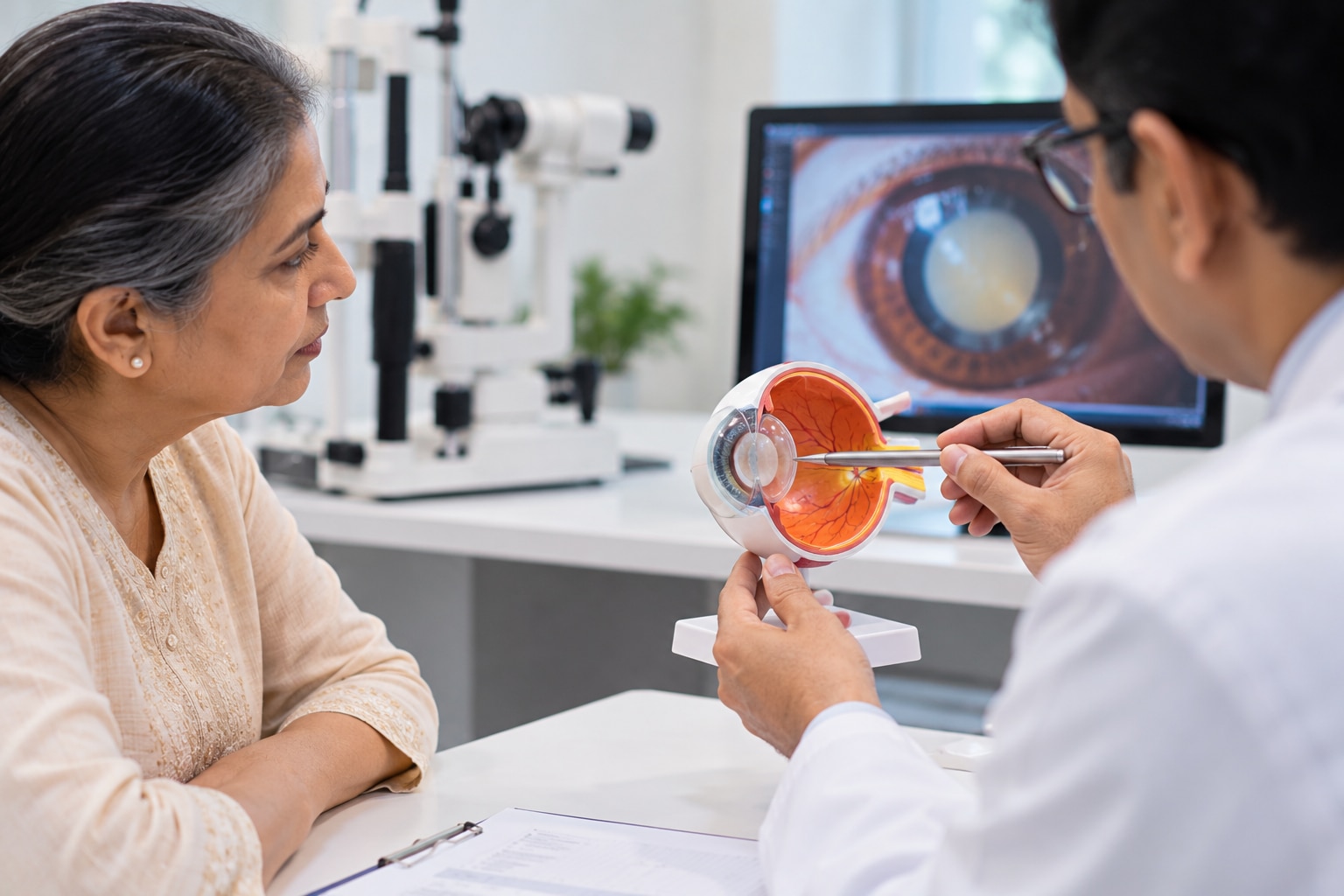
Blurred vision is not enough to prove that you have a cataract, and cataracts do not affect everyone in the same pattern. By comparing the specific changes in clarity, colour, glare, night vision, and daily function, you can recognise when an eye examination is needed and understand what surgery can—and cannot—correct.
Key takeaways
- Cataracts often cause gradual blur, glare, halos, and faded or yellowed colours.
- Book an eye examination when vision changes interfere with reading, driving, or daily tasks.
- Seek urgent assessment for sudden vision loss, severe eye pain, flashes, or a curtain-like shadow.
- Updated glasses and brighter lighting can help until cataract surgery becomes appropriate.
Which vision changes commonly point to a cataract?
Cataract symptoms usually develop gradually, not suddenly. Blurred vision or cloudy vision can make fine detail less clear, while faded colours and yellow vision make whites look cream or objects look yellow-brown. Glare from sunlight, lamps, or headlights and halos around lights often become more noticeable, especially at night.
| Symptom | How it commonly feels | What to notice |
|---|---|---|
| Blurred or cloudy vision | Hazy, washed-out detail at distance or close range | New glasses help less or only briefly |
| Faded colours and yellow vision | Colours look dull, warm, or yellow-brown | Compare a white object with each eye |
| Glare and halos | Lights scatter, producing dazzle or rings | Headlights become uncomfortable |
| Poor night vision | Dim scenes lose contrast and detail | Dark roads or steps become harder to see |
| Frequent spectacle changes | Prescriptions change repeatedly | Clarity does not remain stable |
| Double or ghost images in one eye | A second outline persists with the other eye closed | This can also come from dry eye, corneal disease, or astigmatism |
One eye can be worse than the other, and both eyes open can hide the difference. Cover each eye separately and compare clarity and colour; this simple check can reveal a change you have adapted to.
Cataracts are not typically painful and do not usually cause redness or discharge. Sudden vision loss, a painful red eye, or marked halos with headache or nausea needs prompt assessment rather than being blamed on a cataract. Symptoms alone cannot confirm the diagnosis; an eye examination is needed.
How cataracts change reading, driving, and everyday tasks
A cataract can disrupt daily activities before an eye-chart score looks severely reduced. Glare and halos around headlights, sunlight, or bright indoor lights reduce contrast, making faces, road markings, and steps harder to see. This explains why poor night vision and driving with cataracts can become unsafe before ordinary distance vision seems seriously blurred.
1. Reading becomes slower when letters lose contrast or seem washed out, especially with a posterior subcapsular cataract. Phone screens and television subtitles may require brighter, better-directed light, although excessive light can worsen glare.
2. Recognising faces across a room becomes difficult when haze and contrast loss hide fine detail. Colours can look faded or yellowed, and changing spectacle prescriptions may provide only temporary improvement.
3. Stairs, curbs, and uneven floors become harder to judge when shadows are deep or lighting is uneven. You may hesitate, misjudge a step, or avoid unfamiliar places.
Double vision in one eye, called monocular doubling or ghosting, can make text and lights appear duplicated. A cataract can cause it, but dry eye, corneal disease, and uncorrected astigmatism can do the same.
Seek an eye assessment when symptoms interfere with reading, phone use, television, faces, stairs, or safe travel. Do not wait for the cataract to become “mature”; functional difficulty matters more than a particular chart score, and another eye condition can contribute.
How an eye examination separates cataracts from other causes
A cataract diagnosis cannot come from symptoms alone, and symptoms cannot predict how much surgery will restore. Blur from refractive error versus cataract is separated by testing, because dry eye, corneal disease, glaucoma, diabetic retinopathy, age-related macular degeneration, and other retinal problems can produce similar difficulty.
The examination usually includes:
- Visual-acuity testing for each eye separately
- Refraction to determine whether new glasses improve clarity
- Pupil assessment for unequal responses or other nerve signs
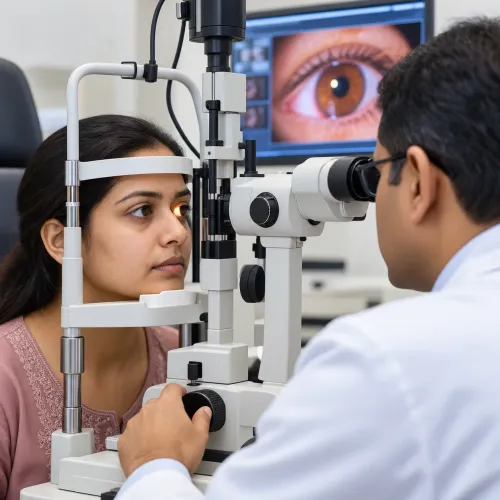
- Slit-lamp examination to inspect the cornea, lens, and cataract location
- A dilated eye examination to view the retina and optic nerve when indicated
Lens location changes the pattern. A posterior subcapsular cataract can cause marked glare in bright light and difficulty reading, while a nuclear cataract more often causes gradual distance blur and an early shift toward nearsightedness.
A slit-lamp examination also helps identify clouding associated with ageing, trauma, diabetes, steroid exposure, or congenital cataract rather than assuming every cataract is age-related.
A cataract can cause ghosting in one eye, but dry eye, corneal disease, or uncorrected astigmatism can do the same. Surgery can clear the lens-related blur while glaucoma, diabetic retinopathy, macular disease, or retinal damage continues to limit vision, so the dilated eye examination matters before estimating the likely result.
When should cataract symptoms be assessed urgently?
Book an eye assessment when vision is worsening, glare interferes with driving, your spectacle prescription keeps changing, or daily tasks become harder. Practical warning signs include difficulty reading, recognising faces, climbing stairs, watching television, or using a phone.
Compare each eye separately by covering one eye at a time; one eye can worsen while both eyes open still seem adequate.
If glare or blur makes the road unsafe, do not drive. Arrange an assessment rather than waiting for the cataract to become “mature.”
| Situation | What to do | Why it matters |
|---|---|---|
| Gradual blur, glare, frequent prescription changes, or trouble with everyday tasks | Book a routine eye assessment | These changes fit cataract concerns, but refraction, dry eye, glaucoma, retinal disease, or another condition can also contribute |
| Sudden vision loss, severe eye pain, or marked redness | Seek prompt or urgent eye care | Cataracts usually develop gradually and are not typically painful or red |
| New flashes and floaters, a sudden increase in floaters, or a curtain-like shadow | Seek urgent assessment immediately | These symptoms can signal a retinal tear or detachment, not an ordinary cataract |
| Marked halos with headache or nausea | Seek urgent assessment | This combination can signal an acute pressure-related eye emergency |
Do not attribute sudden vision loss, severe pain, redness, flashes and floaters, or a curtain-like shadow to cataracts. If you need to see an eye doctor for cataracts, report the timing, affected eye, and speed of every change.
What can help before surgery, and when is surgery considered?
Updated glasses can help when a refractive change contributes to blur, but glasses for cataract symptoms cannot clear an opaque natural lens. Brighter task lighting, anti-glare measures, and treatment for dry eye can make reading or screen use easier temporarily; they manage symptoms, not the cataract.
Cataract surgery is considered when cataract-related vision loss interferes with activities you need or value, not when you reach a universal visual-acuity threshold or the cataract becomes “mature.” Modern cataract surgery removes the cloudy natural lens and replaces it with an artificial lens.
- Confirm the cause. An examination must establish how much of your difficulty comes from the cataract and check for glaucoma, diabetic retinopathy, macular disease, corneal disease, or retinal damage.
- Measure the effect. Explain whether glare, reduced contrast, reading difficulty, unsafe driving, or trouble recognising faces is limiting your daily life.
- Set expectations. Surgery can improve the cataract-related component, but vision lost from glaucoma, diabetic retinopathy, macular or corneal disease, or retinal damage can limit the final result.
- Choose timing. Proceed when the expected benefit outweighs the inconvenience and risks of surgery; waiting is reasonable when symptoms remain manageable.
In Mumbai, an assessment at FOHS's K.B.H.Bachooali Charitable Eye&ENT Hospital in Parel can help separate cataract symptoms from conditions requiring different care before you discuss surgery.
Related service
Cataract Clinic K. B. Haji Bachooali Charitable Ophthalmic and ENT Hospital, located in Parel, Mumbai, provides comprehensive and affordable cataract diagnosis and... View service → |
Frequently asked questions
Which vision changes commonly point to a cataract?
Gradual blurred or cloudy vision, glare, halos around lights, faded colours, and yellow or brown colour changes commonly occur with cataracts.
How can cataracts affect reading, driving, and everyday tasks?
Cataracts can reduce fine detail, make print harder to read, increase night-driving glare, and make faces, steps, signs, or household objects less clear.
How does an eye examination separate cataracts from other causes?
An eye examination checks visual acuity, the lens for clouding, the retina, eye pressure, and other structures that can cause similar vision changes.
When should cataract symptoms be assessed urgently?
Seek urgent eye care for sudden vision loss, severe eye pain, marked redness, flashes, a sudden increase in floaters, or a curtain-like shadow.
What can help before surgery, and when is surgery considered?
Updated glasses, brighter task lighting, anti-glare measures, and safer driving choices can help. Surgery is considered when the cataract limits activities or quality of life.