Persistent ear drainage is not simply an inconvenience: it can signal disease that has spread beyond the eardrum into the middle ear or mastoid. By the end, you will know which symptoms need prompt assessment, when medicines or tympanoplasty may be enough, how surgeons select a mastoidectomy approach, and what trade-offs to discuss before surgery.
Key takeaways
- Seek urgent assessment for persistent drainage, worsening pain, or new facial weakness.
- Cholesteatoma can erode mastoid bone and spread infection beyond the middle ear.
- Doctors choose medicines, tympanoplasty, or mastoidectomy based on disease extent.
- Follow-up checks healing, hearing, infection control, and possible residual disease.
When does a chronic ear infection need urgent specialist assessment?
A chronic ear infection needs prompt specialist assessment when drainage persists, pain intensifies, hearing worsens, or symptoms suggest infection beyond the middle ear. The diagnosis matters:
| Condition | What it means | Usual urgency |
|---|---|---|
| Recurring ear infection | Separate episodes with periods when the ear becomes clear and comfortable | Arrange outpatient review if episodes repeat |
| Chronic suppurative otitis media | Ongoing or repeatedly draining middle-ear infection, usually through a perforated eardrum | Specialist assessment is needed; repeated antibiotics alone are not enough |
| Mastoiditis | Infection involving the mastoid bone and its air cells behind the ear | Prompt specialist review, often urgently |
Mastoiditis symptoms include swelling or tenderness behind the ear, fever, severe ear pain, and foul-smelling or persistent ear discharge. Do not wait for a routine appointment if you develop any of these signs:
- Facial weakness
- Vertigo or severe imbalance
- Severe headache
- Confusion, drowsiness, vomiting, neck stiffness, or another neurological symptom
A dry, stable perforation is different from a continuously draining ear. It still needs assessment, but it does not carry the same immediate concern as active discharge with pain or fever.
Worsening hearing loss deserves review, yet hearing level alone does not determine whether mastoidectomy is needed. Surgery depends on infection control, cholesteatoma, mastoid involvement, and structural damage; a specialist may plan outpatient treatment when the ear is dry and stable, but urgent findings require faster evaluation.
How can middle-ear disease reach the mastoid and cause serious complications?
An infected or poorly ventilated middle ear can spread through its connected mastoid air cells, small spaces in the bone behind the ear. Persistent inflammation narrows drainage pathways and produces granulation tissue, trapped fluid, and progressive bone damage.
A cholesteatoma is not cancer. It is an expanding collection of keratinizing skin in the middle ear or mastoid. As it enlarges, it can erode the ossicles, facial-nerve canal, balance structures, and other nearby bone. Repeated microsuction or drainage control may make the ear look better, but it does not remove this destructive tissue.
| Approach | What it can do | What it cannot do |
|---|---|---|
| Microsuction and culture-directed topical antibiotic drops | Clear debris and control infected drainage | Remove a cholesteatoma or repair eroded bone |
| Oral antibiotics when indicated | Treat selected spreading or systemic bacterial infection | Correct every perforation, blocked space, or structural source |
| Observation | Monitor a dry, stable ear without active destructive disease | Safely manage progressive bone erosion or hidden cholesteatoma |
Untreated destructive disease can spread beyond the ear. Possible consequences include facial-nerve injury, worsening hearing, vertigo, a mastoid or brain abscess, meningitis from ear infection, and other intracranial complications. Mastoidectomy removes diseased mastoid cells and aims to create a safe, dry ear; medicines control infection, but they do not eradicate every structural cause.
How do doctors decide between medicines, tympanoplasty, and mastoidectomy?
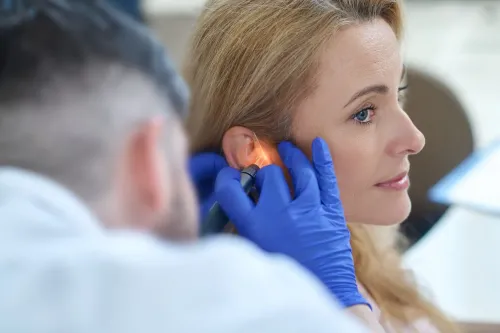
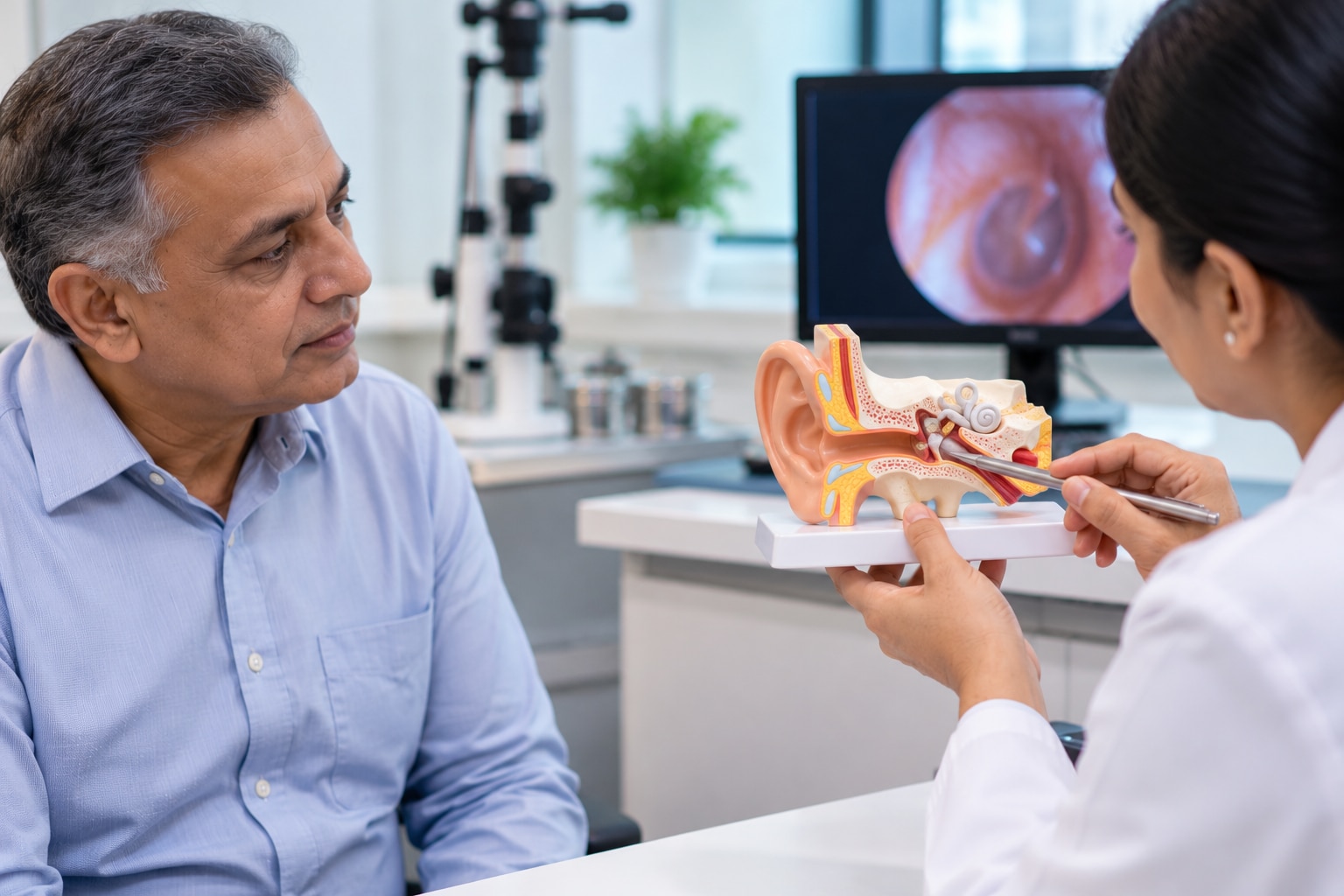
Doctors choose treatment from examination, disease extent, hearing goals, and operative risk—not from “chronic infection” alone. Microscopic otoscopy checks for a perforation, granulation tissue, cholesteatoma, active discharge, and mastoid tenderness. Pure-tone audiometry measures hearing and air-bone gaps.
Before surgery, the team reviews medicines, allergies, bleeding risks, and anaesthesia fitness. They manage discharge with microscopic cleaning, culture-directed topical drops when appropriate, and other treatment; operating through an actively draining ear requires a clear plan.
A high-resolution CT temporal bone scan maps bony erosion, mastoid anatomy, ossicles, the facial-nerve canal, and inner-ear landmarks. CT cannot reliably distinguish every soft-tissue abnormality. Diffusion-weighted MRI is particularly useful for residual or recurrent cholesteatoma after surgery.
| Option | Target | When it fits |
|---|---|---|
| Medicines first | Infection or discharge | Middle-ear disease settles with treatment |
| Tympanoplasty | Eardrum and middle-ear structures | Perforation needs repair without mastoid disease |
| Mastoidectomy | Diseased mastoid cells | Disease extends into the mastoid or is destructive |
| Combined surgery | Both areas | Middle-ear and mastoid disease coexist |
The tympanoplasty versus mastoidectomy choice follows examination and imaging: they show whether disease is confined to the middle ear, extends into the mastoid, or warrants medical treatment first, tympanoplasty alone, or mastoidectomy. Ask: “What disease are you removing, and what will happen if we treat only the eardrum or use medicines?”
Disease control comes before hearing improvement. Discuss these mastoidectomy indications with the specialist team at FOHS's K.B.H.Bachooali Charitable Eye&ENT Hospital in Parel, Mumbai, including whether another approach is safer when mastoid disease is absent or surgical risk outweighs expected benefit.
Related service
Mastoidectomy Mastoidectomy Mastoidectomy is a specialized surgical procedure performed to remove infected or diseased air cells within the mastoid bone located behind the ear. |
Which mastoidectomy approach fits the extent of disease?
The extent and location of disease determine the approach, not your hearing level alone. The surgeon also weighs bone erosion, facial-nerve and inner-ear anatomy, previous surgery, and the priority of creating a safe, dry ear.
| Approach | What it preserves or changes | Practical consequence |
|---|---|---|
| Canal-wall-up mastoidectomy | Preserves the posterior ear-canal wall and more normal anatomy | Hidden residual or recurrent cholesteatoma can be harder to find; selected patients need planned second-look surgery or surveillance imaging |
| Canal-wall-down mastoidectomy | Removes the posterior ear-canal wall for wider access and visibility | It can create a more self-cleaning space, but a mastoid cavity may need periodic cleaning and protection from water or debris |
| Radical mastoidectomy | Removes disease through a more extensive alteration of the mastoid, middle ear, and hearing structures | Used for advanced disease when eradication and safety take priority over preserving normal anatomy |
A canal-wall-up mastoidectomy may suit disease that can be removed while retaining the canal wall, but hidden disease creates a follow-up burden. A canal-wall-down mastoidectomy improves visibility and access when disease is widespread or recurrence risk is a concern.
A radical mastoidectomy is reserved for advanced or destructive disease. It changes normal ear anatomy more substantially and can affect the structures involved in hearing.
Hearing reconstruction may include ossicular-chain repair during the same operation or later. That repair does not decide the mastoid approach; removing disease and creating a safe, dry ear come first.
What should you expect from combined surgery, risks, and follow-up?
Combined surgery often joins mastoidectomy with tympanoplasty and, when needed, ossicular-chain reconstruction. One operation can remove mastoid disease, close the eardrum perforation, and repair damaged hearing bones.
| Goal | What it means | What to expect |
|---|---|---|
| Safe, dry ear | Eradicate disease and control drainage | The main priority |
| Hearing restoration | Rebuild sound transmission | Done during surgery or later, but not guaranteed |
Inflammation, scarring, or inner-ear damage can limit hearing even after successful repair. During mastoidectomy recovery, report worsening hearing, persistent drainage, severe dizziness, facial weakness, fever, increasing pain, or a severe headache.
Recognized mastoidectomy complications include worsening hearing, dizziness, taste disturbance, facial-nerve weakness, cerebrospinal-fluid leak, bleeding, infection, and residual or recurrent disease. Facial-nerve monitoring is commonly used as an aid because the nerve runs close to the operative area, but monitoring does not eliminate injury risk.
Follow-up depends on the approach. A canal-wall-up ear needs inspection for hidden residual or recurrent disease; your surgeon may advise planned second-look surgery or diffusion-weighted MRI. A canal-wall-down cavity may need periodic cleaning and protection from water or debris as instructed.
Before discharge, ask:
- Which approach was selected, and why?
- What water precautions and cleaning schedule apply?
- What hearing improvement is realistic, and when will it be tested?
- Which warning symptoms require urgent review?
- What date or trigger will prompt reassessment?
Frequently asked questions
When does a chronic ear infection need urgent specialist assessment?
Arrange prompt ENT assessment for persistent ear drainage, increasing pain, worsening hearing, fever, dizziness, facial weakness, severe headache, or swelling behind the ear.
How can middle-ear disease reach the mastoid and cause serious complications?
Infection can pass through the air cells behind the middle ear. Cholesteatoma can also erode bone, allowing infection to spread toward the inner ear, facial nerve, or brain.
How do doctors decide between medicines, tympanoplasty, and mastoidectomy?
Doctors consider the cause, examination findings, hearing tests, imaging, drainage, cholesteatoma, and whether disease has damaged or entered the mastoid bone.
Which mastoidectomy approach fits the extent of disease?
A canal-wall-up operation preserves the ear canal when disease control allows. A canal-wall-down operation removes part of the canal wall when wider access and long-term disease clearance are needed.
What should you expect from combined surgery, risks, and follow-up?
Mastoidectomy may be combined with tympanoplasty or ossicular reconstruction. Discuss risks such as hearing change, dizziness, facial nerve injury, taste disturbance, and recurrent disease, then attend every follow-up visit.